Archive for pop culture

Billy the Kid Week 2011: Review of Anything for Billy by Larry McMurtry

Posted in Billy the Kid, books, pop culture, reviews with tags , , , , on July 13, 2011 by Paxton

Billy the Kid Week

Day 3, Hump Day, of Billy the Kid Week. I am celebrating the 130th anniversary of Billy the Kid’s death this week by reading a bunch of books about the famous outlaw.

Today’s book is Anything for Billy by Larry McMurtry.

Anything for Billy

I’ve actually read this book before.  I even wrote an article for one of my Weekly Geeks entries back in 2009 about historical fiction and I mentioned reading this book.  After seeing Young Guns in the theater back in 1988, I became obsessed with Billy the Kid and the Old West.  I read tons of books, fiction and non-fiction, about that time period.  I discovered this book in the early ’90s during a vacation with my family.  The back mentioned it was about Billy the Kid, so I read it.  And I really enjoyed it.  When I wrote that 2009 article mentioning this book, I got the bug to read it again.  So I grabbed a copy off Paperbackswap.com and read it again just a month or so ago.

And the book is still good.  It is most definitely not a shoot ’em up western.  It is more a character study of the western gunslinger.  The book is written as the journal of “Sippy”, an author from the East Coast who packs up and moves West when he becomes disillusioned with his life.  He meets up with Billy Bone and Joe Lovelady and tags along with them on several adventures.  They meet several rough and tumble characters and travel to tiny western towns in the middle of nowhere.  It’s a steady, methodically paced journey.  The book is Sippy’s remembrance of his time with Billy.  Sippy even mentions other characters in the book that have gone on and written their own Billy books years after the events in this book and “misremembered” all the events to make themselves look better.  It’s a nice commentary on legends and fame. And that may be the most interesting thing about this book. It’s a deconstruction of myths and legends and how we perceive and create these legends. Also maybe the juxtaposition of the reality of a legend against what people believe about the legend. Very interesting stuff when you think about it.

Anything for Billy

McMurtry chooses an interesting portrayal of Billy.  He’s a terrible shot with a pistol or rifle (which is historically inaccurate).  McMurtry describes him as ugly (also not historically accurate).  And this book’s Billy is also extremely immature and a slave to his own impulses (probably very historically accurate).  However, it’s obvious McMurtry was looking to create his own version of Billy the Kid because while he uses a few historical places in Billy’s life, the characters and events are mostly fiction.

So, did I enjoy it again this second time?  I did.  It’s a fun lazy Sunday western.  And I like how it’s written, with the main character Sippy remembering the events of so long ago and how he can mention what happens to some of the characters many years later.  I did enjoy it and I can recommend it to fans of Billy the Kid or western outlaws. Or anyone that loves a good western. But, go in realizing this isn’t a “shoot em up”, it’s more about the characters than the action.

Billy the Kid Week 2011: Review of The Illegal Rebirth of Billy the Kid

Posted in Billy the Kid, books, pop culture, reviews with tags , , , , on July 12, 2011 by Paxton

Billy the Kid Week

This week I am celebrating the 130th anniversary of the killing of Billy the Kid by Pat Garrett.  I’m reading books that feature either the historical Billy the Kid or a fictional version of Billy the Kid. Yesterday I looked at a comic series featuring the character of Billy the Kid.  Today we look at a science fiction story involving A clone of Billy.

Illegal Rebirth of Billy the Kid

Today’s book is called The Illegal Rebirth of Billy the Kid by Rebecca Ore. I found it during my search for Billy the Kid books and I’d never heard of it. The basic story line seemed interesting enough so I got it off paperbackswap.com and read it a few months ago.

On the surface it sounds awesome. The story takes place in the future. Cloning is legal but heavily policed. A government scientist creates an illegal Billy the Kid clone which escapes, and wrecks havok. Because the clone is illegal, the government sends out assassins to capture or kill it and find out who made it. The clone goes on the run like the real Billy the Kid, receiving help from a clone activist group, until Billy finally confronts his pursuers. But the book doesn’t completely go that route. For starters, we find out pretty early that this clone isn’t actually a clone of Billy the Kid. The clone was grown from generic government clone DNA and given flash memories based partly on historical record and partly on pop culture myth. Immediately that disconnected me. This clone could literally have been anyone and that hindered my enjoyment of the story.

Clone Commandos
These clones would have worked better.

Two, nothing really happens. “Billy” does get help from an activist group, then he has to get a fake id and a job. He is constantly lamenting the fact he’s just a clone and not the actual Billy the Kid. He’s not really “on the run”. He’s in hiding. Notice the difference. One implies action, the other doesn’t. Guess which.  Also, the story does imply that the government will, in fact, send out clone assassins (assassins who are themselves clones) to eliminate potential risks.  Awesome.  But this story only mentions it.  The bad ass subplot of the clone assassin hunting down one of his own kind who happens to be a created copy of one of the most notorious outlaws in American history never happens.  It’s just left to dangle there.  We then get the clone “Billy” working a deal with the government to reveal the scientist that made him in return for protection.  Just not enough there to actually make me care about the characters or what was going on.

I think I see where Ore was trying to go, though.  Maybe using this story as an analogue for societal classes or maybe even racism.  Clones are thought of as not really even human.  They are called meat dogs or meat pigs.  Some even consider them pets.  You also have the clone activist group helping clones get away from abusive owners, much like the Underground Railroad back during the Civil War did for blacks.  A lot of this is just barely under the surface in the story, but I didn’t care because the story was so goddam boring I just wanted it to end.

That pretty much wraps up the longest 210 pages I’ve ever read in my entire life.  This story would probably have worked better in 100 pages.  And maybe a re-write of the ending.  But I can’t recommend it.  I was bored to tears through the majority of the book.

25th Anniversary Review of John Byrne’s Man of Steel Part II

Posted in 80s, comic books, pop culture, Superman with tags , , , , on July 7, 2011 by Paxton

Superman Week

John Byrne’s historic six issue mini series, The Man of Steel, just turned 25 years old.  The series would (re)introduce Superman after the Crisis on Infinite Earths mega event which finished up early Summer 1986.  I am reviewing the series for it’s 25th anniversary. On Wednesday, I reviewed issues #1 – 3. Today, I’m going to review issues #4-6.  For more information about Crisis on Infinite Earths, see my article on Strange Kid’s Club here.

MOS 4
Issue 4 gives us a full introduction to the new Lex Luthor. Instead of the bald mad scientist we all know, Lex has been re-imagined into more of a business mogul, a la Donald Trump. And I think it works much better. In the beginning of this issue, Clark and Lois are going to a party thrown by Lex, so Lois shows up at Clark’s apartment to pick him up. We see several awesome panels of Clark shaving with his heat vision and Lois discovering Clark’s barbells which he keeps to explain why he is in such great shape. But Lois comments they are too light for Clark to keep such a great figure and Clark has to mentally remind himself to get heavier weights (he can’t judge very well because he has super strength). Clark and Lois then head to the event on Luthor’s yacht and it is besieged by terrorists during the party. Superman saves the day, takes down the terrorists, and then Luthor tries to hire him into his payroll all while explaining that he knew the terrorists were going to hijack the boat but he did nothing so he could see Superman in action. The mayor was in attendance and justifiably angry that Lex put all of his party goers in danger, so he has Superman arrest Luthor.  Luthor’s lawyers have him out in less than two hours but afterwards he confronts Superman and literally threatens to kill him in front of everyone in the city in the near future.  And boasts that he’ll never be arrested for it.  It’s intense.

MOS 5
In issue 5, Byrne starts things off with a clever inside joke.  There is a great shot of Superman holding up Luthor’s green battle armor from the Kenner Super Powers toy line.  A sly little reference that illustrates why I love Byrne’s writing.  Anyway, this issue introduces Bizarro although he’s never really called that within the story.  In the beginning, we see Superman holding the aforementioned green armor in front of Luthor accusing him of a bunch of things having to do with that armor.  Luthor, of course, feigns ignorance and lists out all the reasons why Superman can’t prove Luthor had anything to with the armor.  Realizing he has no proof, Superman leaves while proclaiming that he will someday make Luthor pay for all of his crimes.  While he was in the office, Luthor scanned Superman’s cellular structure with the intent of creating a super duplicate. The results are immediately fed into a cloning tank (instead of waiting to properly analyze the data) that seemingly successfully creates a duplicate of Superman. However, the duplication process was built on the assumption Superman was a mutated human being and the discrepancy caused the duplicate to fail and collapse (which, as I said, could have been avoided by properly analyzing the data first). Luthor, now armed with the knowledge that Superman is an alien, orders the duplicate destroyed.  Next, we meet Lois’ blind sister Lucy. She is so distraught by her recent loss of sight that she attempts to jump off the balcony of her sister’s apartment. Bizarro saves her (we have to assume he escaped because we aren’t told), but she’s blind so she thinks it’s Superman. Superman runs into Bizarro, who has disguised himself as a Bizarro-Clark, and immediately gets into a fistfight with him (sort of a hallmark of Byrne’s Superman). They battle each other for the rest of the issue throughout downtown Metropolis. Finally, Bizarro and Superman collide in a spectacular mid-air collision that reduces Bizarro to a fine dust that falls over Lucy Lane and cures her blindness.  We are led to believe that the creature somehow knew its sacrifice would cure Lucy’s blindness.

Continue reading

25th Anniversary Review of John Byrne’s Man of Steel Part I

Posted in 80s, Batman, comic books, pop culture, Superman with tags , , , , , , , on July 6, 2011 by Paxton

Superman Week

John Byrne’s historic six issue mini series, The Man of Steel, just turned 25 years old.  It was released during the Summer of 1986 to “clean up” the ever increasing super powers and ever more complicated back story of DC’s flagship super hero. For years, this series was the official origin of the post-Crisis Superman.  What’s “post-Crisis”?  Glad you asked.

Twenty six years ago (Apr 1985), DC released their multiverse changing event Crisis on Infinite Earths. I discussed the genesis of that historical mini-series over on Strange Kid’s Club in a very special installment of Forgotten Favorites. That megaseries changed the landscape of the DC Universe. It ushered in a time of change. Heroes died.  Heroes lived.  But after all was said and done, everyone had to pick up the pieces and move on.

Crisis #1

DC was using the event to update and modernize their heroes. After the event was over,  George Perez would relaunch the post-Crisis Wonder Woman.  Batman’s origin would be expanded and revamped in Frank Miller’s famous Batman: Year One. And it also was time for DC to give Superman a new start. In the years leading up to Crisis, Superman had become entirely too powerful. I talked about some of his more ridiculous “super powers” earlier this week. The time of Superman igniting suns with his heat vision and juggling planets had come to an end. Crisis writer Marv Wolfman pitched DC on a Superman reboot that would eliminate the super pets, the surprisingly large number of Kryptonian survivors and power down the Man of Steel to more “normal” levels. Wolfman even wanted to eliminate Superman’s adventures as Superboy. Surprisingly, Wolfman made a similar pitch to DC back in the 70s but they rejected it. Now DC was all ears.

Wolfman decided to hire popular writer/artist John Byrne (who had just left Marvel) to help him flesh out the details of the story. Wolfman and Byrne sequestered themselves away and came up with a multi-year plan for the new Man of Steel.  A month or so after the end of Crisis on Infinite Earths, John Byrne would kick off Superman’s triumphant return with a 6 issue mini-series (re)introducing the new post-Crisis Superman to comic readers.  At the end of that series, Byrne would take over writing and drawing Action Comics and the new Superman title and Marv Wolfman would take over writing Adventures of Superman with Jerry Ordway drawing.

Man of Steel 1b

Each issue of Byrne’s 6 issue series would re-introduce aspects of the Superman mythos back into the DC Universe.  I’ll take a quick look at the first 3 issues today, then I’ll look at the final three issues tomorrow.  I haven’t read this series since the mid ’90s, so it’ll be interesting to see if it’s still any good or if it’s totally dated.

Let’s find out.

MOS 1a
Issue 1’s prologue begins on Krypton and we learn that this new Krypton is very similar to the Richard Donner version from the movies. It’s very scientific, the landscape is antiseptic and the people are detached from each other. However, despite being highly evolved, their planet is dying. Jor-El is making preparations to rocket his son to Earth. He explains to Lara that he chose Earth because the yellow sun would super charge his Kryptonian cells, making him a “super” man and superior to humans so he can one day rule the planet. The rocket takes off, we see the planet explode and then the prologue ends. We pick up with Clark in high school. He’s a football star. A jock. And kind of a douche. And he’s unaware that he’s an alien. Pa Kent shows him the crash site and explains how he was found in the fields after crashing to Earth. Clark must come to terms with not being human and learning to deal with his burgeoning powers. In the epilogue we see Clark, with help from Ma and Pa Kent, create his super suit and the disguise for Clark Kent. The suit is normal fabric. We learn that Clark emits a force field around his body that protects things close to him, like his clothes. Things outside the field, like his cape, can be torn up or destroyed.

Continue reading

12 of Superman’s Most Absurd Pre-Crisis Super Powers

Posted in 80s, comic books, nostalgia, pop culture, Superman with tags , , , , , , , on July 4, 2011 by Paxton

Superman Week

Everyone knows the many standard powers of Superman; fly, super-strength, super-speed, super-breath, invulnerable, heat-vision, etc.  Not everyone knows, though, that he didn’t always have many of these abilities. Not only that, Superman has several other super powers that are less used, but still kept in his back pocket for just the right moment when he can whip it out and dazzle everyone.

As the years went on, and writers kept getting more…”creative”…Supes powers were quickly growing and getting more out of control. These little known powers had stacked up over the years until finally DC had to say, “Dammit, that’s enough” and launched the massive Crisis on Infinite Earths event to just level the playing field.

Let’s take a look at some of the lesser known, and therefore more humorous, of Superman’s Pre-Crisis abilities .  I’ll include panels of Superman using the ridiculous powers when I can.  If you have trouble reading the text, click the images to make them bigger.

Super Ventriloquism 1 Super Ventriloquism 2
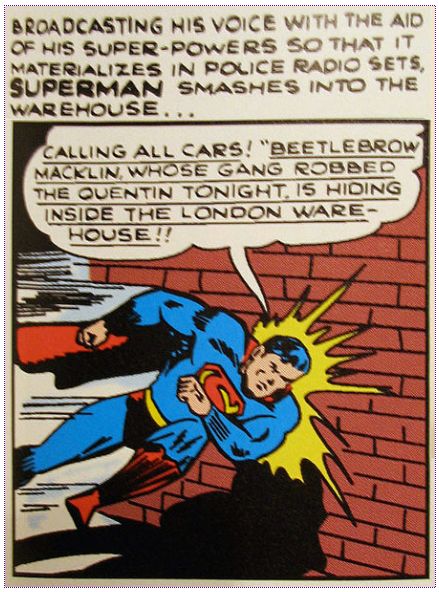
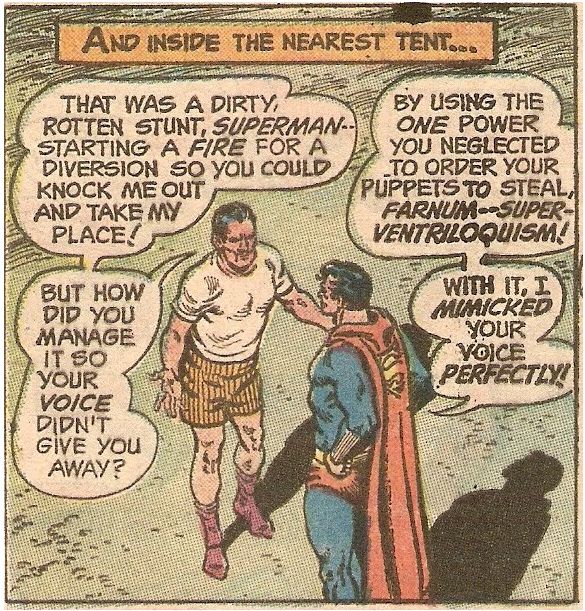
Super-Ventriloquism and other voice “powers” – Not only Super-V, he had a whole bag full of voice powers that writers tended to wield at their hip like gunslingers. Superman could throw his voice over great distances and also possessed super-voice-mimicry, which means he could make his voice sound like anyone else. That power must come in handy at parties when you are stuck talking to the guy who won’t leave you alone and keeps asking you to come check out his “sweet van” out in the parking lot.  The one painted all white with no windows (aka RAPE van).  If you were Supes, you could throw your voice across the room as someone else calling your name and you can get the hell out of there. Nicely done, Superman.  Or, you could just punch a hole in the rapist’s face because you are, you know, SUPERMAN.

Super Mathematics
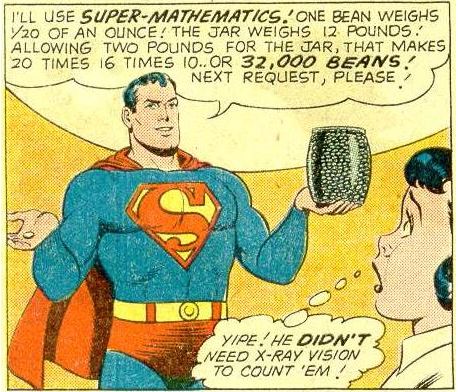
Super-MathematicsSuper Mathematics? That looks a lot like regular mathematics to me. By the way, Super Douche, isn’t 20 x 16 x 10 = 3,200?

Super Weaving
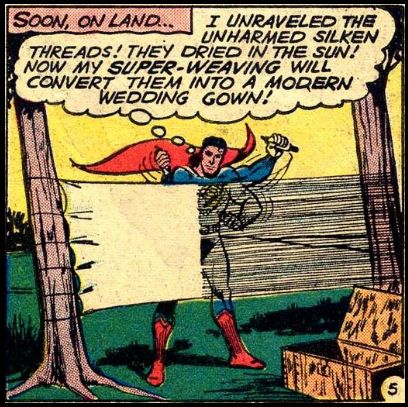
Super-Weaving – Yes, that actually happened.  Super weaving.  Not weaving at super speed.  Super-weaving.

Super Hypnosis
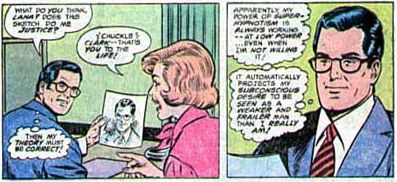
Super-Hypnosis – Apparently this is why no one recognizes Clark Kent is Superman.  And it apparently works even when he isn’t concentrating on using it (I guess that’s what makes it super hypnosis?).  However, I prefer to ignore this power and assume that everyone in Metropolis is just that dumb to notice they are the same person.  Or they really just don’t care.

Super Telepathic Will Control
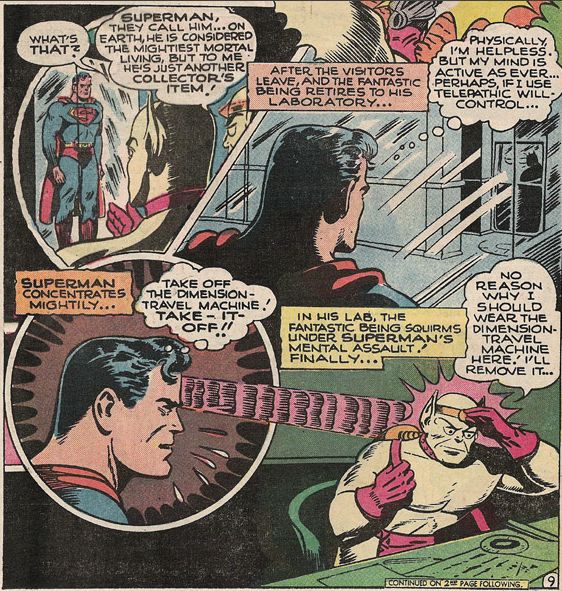
Super-Telepathic Will Control – In an early issue of Superman where he’s kidnapped by aliens, he whips out telepathic will control, which allows him to override someone’s mind and make their body do whatever Superman wants.  If he can do this, then why would he ever need Super Hypnosis?

Continue reading