Archive for Book Report

Review of The Talisman for the #Talismanalong

Posted in books, pop culture, Stephen King with tags , , , , , , on September 4, 2013 by Paxton

Talismanalong 1
Talismanalong 2

Well, the Talismanalong I started with Trish at the beginning of August has ended. We’ve all read the book. We had some good discussion on Twitter under #Talismanalong about the book. It was a lot of fun, I enjoyed reading and talking about the book with the participants.  It’s always fun to do these things especially with Trish, she’s just so much fun.  And, she’s due for a tiny human to come out of her at any moment, so let’s all hope that goes well.

Now, though, I guess it’s time to talk about what I thought about the actual book.

The Talisman The Talisman

Going in, I was not overly excited to read this book. I honestly had no idea what type of story to expect as I knew very little about the book other than the fact that it existed.  I think I was also colored by my “meh-ness” about King’s The Stand.  And the beginning of this book did NOT allay my fears.  The first 80 pages or so are rough (ie boring as ballz).  I was concerned that I may have made a huge mistake.  Then we are introduced to Speedy and The Territories.  And the story takes off.

This book reminds me a lot of The Stand.  The long, epic journey.  I said before that The Talisman is The Stand as written by Neil Gaiman.  Speaking of Neil Gaiman, another book that this reminds me of is American Gods.  One, central “evil” character that must be defeated.  Long, epic journeys, climatic final battles.  Many fantastical elements.  Another book this reminds me of?  Odysseus by Homer.  A hero must fight trial after trial on a long journey to find his way home.  So, yes, this is classic storytelling by two masters of genre storytelling.

Things I liked?  I said this book reminds me of The Stand a little bit, but unlike The Stand, this book has a manageable cast of characters and a much more focused story line.  I didn’t feel like I was drowning in characters and plot throughout reading the book.  I also love the idea and execution of The Territories.  I liked the hero Jack.  I liked his companion Wolf.  For the most part, I think Morgan Sloat is a good villain, but he’s surprisingly not that fully developed considering the length of the story.  I also actually like the final confrontations and wrap ups in this book (unlike, oh, I don’t know, THE STAND).

What didn’t I like? Again, I hate to harp on this with King, but, the story is just too damn long.  This book could have edited out at least 100 pages and not really lost anything.  There is A LOT of naval gazing throughout the different parts of this book.  Especially towards the end.  While it’s more focused than The Stand, it still needed some judicious trimming.  I found “story fatigue” setting in around page 550-600 (there were 770 pages in this book).  Even though I liked the book, I was sort of ready for the final act and wrap up.  It really felt like it took a week to read the last 150 pages or so.  But to be fair, part of that is my inability to find time to read outside of work and on weekends.  With a 2 year old and an 8 month old, reading at home is a rare occurrence.

So, overall, yes, I thoroughly enjoyed this book.  And that is a surprise to me.  Will I read the sequel, Black House?  A week ago, I was gung-ho to read it, yes.  But now, I think I’ll eventually read it, but not anytime soon.  Plus, the stuff I hear from people about the sequel is not exactly glowing.  And I hear it has a thin connection to the Dark Tower series of which I am not a fan.  So, we’ll see.  But I can definitely recommend The Talisman as a good and interesting story, with good characters and a lot of imagination.

And now that I know I like this book, I definitely be reading Straub’s Shadowland sooner rather than later.

Thanks, Trish and everyone else for joining me on this Talismanalong. I had a lot of fun.

Superman Week 2013: BB Hiller’s Superman IV novelization (1987)

Posted in books, comic books, movies, Superman with tags , , , , , , , , on June 20, 2013 by Paxton

Superman Week

So the new Superman movie, Man of Steel, made it’s theatrical debut on Friday.  To celebrate, I thought it would be fun to do another Superman Week.  I convinced CT over at Nerd Lunch and Robert over at To The Escape Hatch to join along.  So leap in a single bound over to those wonderful blogs and see what Superman content they are offering up this week.

Continuing Superman Week 2013 with another look at one of the Superman novelizations.  Here’s a review of the Superman IV movie novelization from 1987.  And yes, I’m pretty sure I hate this weird cover.

Supes 4 novel

The book is written by B.B. Hiller who is a veteran of movie novelizations. This guy has penned novelizations for Little Monsters (the one with Howie Mandell and Fred Savage), Ghostbusters II, Big, ALL of the 90s Teenage Mutant Ninja Turtles movies and ALL of the Karate Kid movies.  So this guy has been around…so to speak.  Unfortunately, or fortunately depending on how you look at these things, Hiller didn’t adapt any of the other Superman movies.  Only this one.  The last one.  And, ostensibly, the worst one. However, to be perfectly honest, I’m a fan of this last Superman movie.  Don’t get me wrong, it’s absolutely f**king terrible but I love it anyway.  And I wanted to see if the book makes an attempt at explaining ANY of the crazy ass insanity that goes down in the movie.  A quick check of the page count (144) tells me that, no, this probably won’t explain a g**damn thing.  But I decided to try it anyway.

The verdict?  It’s actually not that bad.  Somehow, the ridiculous story on the page comes across better than it does on the big screen.  However, there are several added scenes and subplots that help explain some of the ridiculousness.  Just so you know, about 45 minutes of footage was removed from Superman IV including an entire subplot about a first failed attempt by Lex to create a Nuclear Man.

Continue reading

Superman Week 2013: William Kotzwinkle’s Superman III novelization (1983)

Posted in books, movies, pop culture, Superman with tags , , , , , , , , , on June 19, 2013 by Paxton

Superman Week
It’s Day 3 of Superman Week.  I convinced CT over at Nerd Lunch and Robert over at To The Escape Hatch to join along.  So leap in a single bound over to those wonderful blogs and see what Superman content they are offering up this week.

For Superman Week in 2006 (“celebrating” Superman Returns), I reviewed all of the Christopher Reeve Superman movies. So, for the release of this new Superman movie, I thought I’d go back and read the novelizations to two of those same movies. There weren’t novelizations of the first two Reeve Superman movies most likely due to a clause in screenwriter Mario Puzo’s contract that forbade anyone other than him from writing the novelizations. But for whatever reason, Puzo never got around to writing the books.  So Warner Books only released novelizations for the second two movies.  I looked forward to reading these novelizations because I love the two Superman sequels in a retarded sort of way and I wanted to see if there was any more awesomely insane weirdness in the books.

So, today, let’s take a look at the novelization to Superman III.

Written by William Kotzwinkle, the guy who also wrote the ET novelization.  The overall structure of the movie story is intact in the novelization.  The biggest difference with the book is that Kotzwinkle adds a sh*t ton of internal dialogue by nearly every character, but mostly Superman/Clark and Gus Gorman (Richard Pryor).  Many of the internal monologues are weird and in the case of Superman/Clark, completely against character.  A lot of Clark’s internalized conversations are him saying how he could fly someone he doesn’t like to the moon and leave them there.  You know, stuff like, “If only you knew I was Superman…” or “If I could, I would <fill in the blank with some super powered vengeance>”.  I’m fairly certain these are supposed to setup the evil Superman later in the book, but I wasn’t buying it.  It was against everything you think about Clark and Superman.

And as for Gus Gorman.  Ugh.  I didn’t really like Pryor’s character in the movie.  Pryor did good with what he was given, but the character was dumb.  This guy who can’t hold a steady job discovers that he’s some idiot savant when it comes to “computers”.  What?  And it’s even worse in the book.  It’s made more clear in the novel that Gus literally has no idea what he’s doing or how he’s doing it.  It’s like all of his computer skills are some sort of super power he can only barely control.  Pryor makes the character somewhat likeable, but you don’t have that luxury in the novel.  And it’s painfully clear that Pryor ad-libbed many of his lines in the movie because in the book, the dialogue for Gus might be some of the worst written crap I’ve ever read.  Filled with weird late 70s-early 80s colloquialisms that make no sense.  Pryor must have agreed because in the movie, he gets the same information across but in a better way.

As for the villains, the characters of Ross and Vera Webster and Lorelei aren’t much better in this novel than they were in the movie.  Their back stories are fleshed out a little.  We get that Vera is fiercely protective of her brother and craves his approval in everything she does.  There are even a few flashbacks to their childhood.  Lorelei, is still mostly one dimensional.  A poor man’s Miss Tessmacher.  She’s pretty and the book expands a bit more on the fact that Lorelei is actually smarter than everyone thinks she is.  But it’s honestly to no further end.

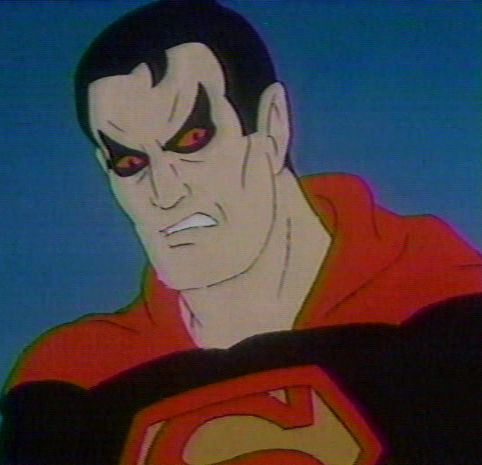
Unfortunately, there’s no extra story to the evil Superman stuff.  I was hoping we’d get more scenes, but we really don’t.  Although, the book does say that Superman’s suit turns fully black and his eyes glow green.  THAT is pretty awesome and I wish the movie would have taken it the whole way.

evil_superman_superfriends
I’m Superman. BITCHES.

The book’s climax is essentially the same.  Not really much to add.  No further explanation about how Gus came up with the Super Computer idea.  It’s essentially taken from drawings on napkins to fully realized in the cave.  Who developed the AI software the computer runs on?  Gus?  He acts like he’d never seen the computer before when he walks into the cave after riding the donkey down the mountain.  Don’t you think he would have supervised the entire construction?  When the computer shoots the “correct” Kryptonite ray at Supes, how does the computer synthesize the .052% of unknown in the chemical makeup?  It’s UNKNOWN to humans.  Stuff like this needed a better explanation.

I was very disappointed with this book.  I love movie novelizations and it’s rare that I don’t actually enjoy one.  Especially if I like the movie.  I didn’t like this and I can’t recommend it.

If you want a peak into the Superman III movie that could have been, take a glance at this unused Ilya Salkind story treatment.  Prepare for appearances by Supergirl, Brainiac and Mr Mxzyptlk.  It’s weird, but I think it could have been spectacular.

Reading Forrest Carter’s Josey Wales novels

Posted in books, Genres, movies, Western with tags , , , , , on May 31, 2013 by Paxton

Gunfighters

I have been a fan of Clint Eastwood’s 1976 western The Outlaw Josey Wales since I first saw it with my dad back in the 80s.  I actually saw and know Clint Eastwood more for Josey Wales than I do “The Man with No Name” because I saw it first and it led me to Leone’s “Dollars Trilogy”.  So, being a fan of it for so long I was surprised a few years ago when I discovered the movie was actually based on a 1973 book by Forrest Carter called Josey Wales: The Rebel Outlaw.  The story would subsequently be retitled Gone to Texas.

Being such a huge fan of Eastwood’s take on the character I felt I needed to read the source material. So I got the above book from Paperbackswap.com and set about reading about one of my favorite gunslingers.

I have to say, I’m really surprised how close to the story the movie was. Carter writes a very good, gritty, action-y western. The feel on the page is the same as watching the movie. It helped that I had Eastwood’s visage burned into my brain whenever I hear the name Josey Wales. The mannerisms, the speech. It’s obvious Eastwood was very respectful of the original stories and strayed little from not only the character but the overall storyline. The only thing I think the book does better is the character of Laura Lee is a much better character in the book. But, honestly, I’m not a big fan of Sondra Locke, so that may have been a factor.

But the book, I can honestly recommend it for both fans of Eastwood’s movies and fans of good, western action in general.  The book is a fast paced read, clocking in at around 200 pages and offers a lot of gunfights and good dialogue.  It actually got me excited to read Old West fiction again, something I haven’t really done since high school.

In 1980, Carter followed up Gone to Texas with a sequel called The Vengeance Trail of Josey Wales.  This sequel was also included in my book copy.  Needless to say, I was pretty eager to read this sequel and see what could have also been a sequel to Eastwood’s Josey Wales (Eastwood did consider doing it but it never developed).

Josey Wales - Eastwood

The story picks up a short time after the original book.  A terrible tragedy befalls Josey Wales’ bride and his newborn child.  Honestly, the tragedy is told in detail and it’s pretty horrific to read, especially as a father.  And the rest of the book is also incredibly violent, even more so than the first novel which is not as much as you’d expect.  However, I was pulled in again by Carter’s writing style and the way he tells a story.  It’s another excellent Josey Wales novel and I liked it as much if not MORE than the original.

It’s sad that Carter never wrote anymore Wales novels.  I know Eastwood had the book and I think he was considering, but by 1980 I think he wanted to do other movies and leave the Western behind.  When he did his final Western, Unforgiven, I was surprised that the main character wasn’t Josey Wales, however, there may have been rights issues.

So if you enjoy good action, you can’t go wrong with these Josey Wales books.  They are excellent examples of fast paced Old West fiction that I personally enjoy reading.  Do yourself a favor and give it a chance.

Bionic Review: Cyborg IV by Martin Caidin (1975)

Posted in Bionic Man, books, Six Million Dollar Man, TV shows with tags , , , , , , on March 4, 2013 by Paxton

Bionic Review

SMDM Book

Martin Caidin wrote his fourth and final Steve Austin novel in 1975. It was called Cyborg IV.

Cyborg IV Cyborg IV

By this point, Caidin’s character had spun off into the famous Six Million Dollar Man TV show.  However, Caidin continued his novels as if the TV show didn’t exist.  The continuity within the novels did not overlap with the show.  Despite this fact, this particular book was included as #6 in the Six Million Dollar Man book series.  Which is confusing (is it Book #6 or Book #4?).  The Six Million Dollar Man book series were paperback translations of episodes of the TV show in which authors like Mike Jahn and Jay Barbree novelized episodes like Pilot Error, Rescue of Athena One and Solid Gold Kidnapping.  Caidin’s third Cyborg novel, High Crystal, was also confusingly included in this series.  The first two Cyborg books were not included.

For this last novel, Caidin takes the idea of “man working in tandem with machines” to a new level.  Steve is introduced to a new project within the Army in which an advanced fighter jet/spaceship is directly connected to a human pilot so that ship and man are one and the same. This setup requires that the human pilot have interface ports surgically added to his body, but since Steve already has most of that done, Oscar thinks he’s the perfect test pilot for the project.

The idea that Caidin introduces here is pretty cool.  When directly connected to the ship, Steve would “feel” and “see” what happens to that ship as if it were a part of his body.  Instead of having gauges and digital readouts tell him about the telemetry of the ship, it would be fed directly into his body and he’d know it just as he knows that it’s cold outside or that he’s hungry.  It’s a pretty crazy idea and for some reason it immediately made me think of the Clint Eastwood movie Firefox.  And the first time they test Steve and the plane, they have to dial back the connection to 30%, otherwise, Austin may lose all of his individual identity and become “one” with the ship.  The way it’s written in the book is actually pretty cool.

The problem?  Caidin is his own worst enemy.  We spend the first 1/3-2/3 of the book learning about the project and then training Steve on the equipment.  The final action of the book is really just the very first outer space flight test for the plane/cyborg hybrid.  There is a small conflict with the Russians in that they are destroying US spy satellites, but other than that, the book is just training and a few test flights of the new ship.  And the book essentially just ends not giving you any indication about the future of the project or where Steve will go next.

So, again, I’m a little frustrated reading these Caidin Cyborg books because the author has really good ideas but the written execution of the novel is seriously lacking.  And considering the books are short, (< 200pgs) Caidin still manages to drone on WAY too long about the most mundane things.  So while I’d recommend this more than Operation Nuke it’s not as good as High Crystal or the original Cybog novel.