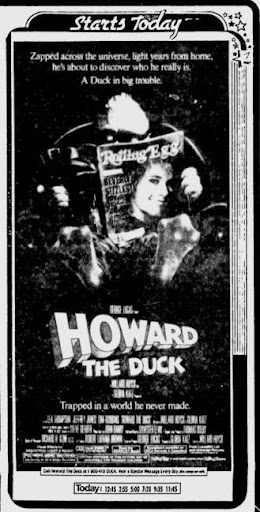
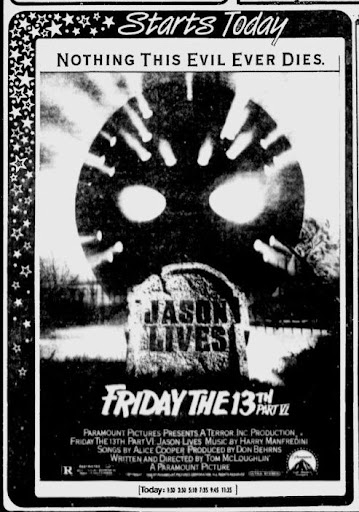
Two diametrically opposite movies began playing in theaters on August 1, 1986, 25 years ago today.
The first movie was the infamous Howard the Duck. Featuring a woman falling in love with a duck and an early appearance of Tim Robbins. This movie nearly ruined Lucasfilm.
The second movie was Friday the 13th VI: Jason Lives. This installment is arguably one of the best movies in the Jason franchise. Jason had died in the last movie, so a lightning strike would revive him and begin the reign of “zombie Jason”. Plus it features the third actor to play the character of Tommy Jarvis.
Check out the trailer for both of these movies at Held Over.
Billy the Kid, aka William H Bonney, aka Henry McCarty, was killed by sheriff Pat Garrett in Fort Sumner, New Mexico 130 years ago today. All this week I am celebrating the anniversary of Billy’s death by reading and reviewing books about the enigmatic outlaw.
Today I am reviewing the book about Billy. The main source of most of our information about him. The book was released within a year after Billy was killed and written by the main who killed him, Sheriff Pat Garret. That book is called The Authentic Life of Billy, the Kid. Before I get started, I want to say I’m sorry if this runs a little long. It’s just such a seminal work in Old West literature and a very important book for me personally because of my enthusiasm for the subject matter. I’ll try to keep it short, but I may let my enthusiasm get away with me.
The two covers above are for one of the original printings of Garrett’s book around 1882 (left) and the more recent printing of the book in the Oklahoma Library Press Western Frontier series (right). The latter printing being the one I read. The official title of the book tends to change a bit with each edition. The title page of the edition I read has An Authentic Life of Billy, The Kid: The Noted Desperado of the Southwest Whose Deeds of Daring and Blood Made His Name a Terror in New Mexico, Arizona and Northern Mexico. The cover of the earlier edition just has An Authentic Life of Billy the Kid The Noted Desperado of the Southwest. It was ghost written by Ashmun Upson, a sheriff buddy of Pat.
This book is considered the authority, but many people don’t realize there was another first hand account of Billy’s death. John Poe, a deputy who rode with Garrett the night Billy was killed, wrote his version of the events of that night. It was released in Wild World Magazine in 1919 and then collected into a hardcover titled The Death of Billy the Kid in 1933 (cover above). Poe’s account mostly matches up with Garrett’s but there are a few inconsistencies between the two.
I got Garrett’s book off Paperbackswap.com. You can also buy copies from Amazon.com or BarnesandNoble.com. Or, if you prefer, you can just read it for free on the internet. I’ve wanted to read this book for years and I thought the 130th anniversary of Billy’s death is as good a time as any.
This book is an interesting read. It’s fascinating on many levels. It’s a first hand account of events in the Old West. That alone is interesting. Plus, it details the events in Billy’s life by someone who knew him and it supposedly details the events of his death by the man who killed him. However, it’s obvious that this book was a PR move by Sheriff Garrett. Billy was very popular with the people of New Mexico and the way Garrett supposedly killed Billy in the dark in what can only be called a surprise ambush was certainly frowned upon. Garrett needed something to “clear the air” and tell his side of the story…however true that side was. Immediately several things are called into question. The first half of the book is obviously written by Ashmun Upson in the style of the old “dime novels”. The events in Billy’s life are portrayed in fantastic style. Plus, many of the supposed events are suspiciously similar to tales of outlaw daring-do from other dime novels. Some of the wording of the stories isn’t even changed from stories printed in the 1840s. The last half is written in straight forward frontier prose by Sheriff Garrett. He meticulously tells the tell of his hunting down and killing of The Kid.
However, his events and details don’t really mesh up with each other and he contradicts himself several times. A few days before he kills Billy, Garrett mentions that his party stumbled upon some voices talking in an orchard. They could also see a shadowy figure walking around but couldn’t identify him. Garrett would later find out it was, in fact, Billy. Then, on the night of the killing, Garrett says he couldn’t see Billy’s face but he immediately recognized his voice. If he could easily recognize just Billy’s voice, why didn’t he in the orchard?
John Byrne’s historic six issue mini series, The Man of Steel, just turned 25 years old. The series would (re)introduce Superman after the Crisis on Infinite Earths mega event which finished up early Summer 1986. I am reviewing the series for it’s 25th anniversary. On Wednesday, I reviewed issues #1 – 3. Today, I’m going to review issues #4-6. For more information about Crisis on Infinite Earths, see my article on Strange Kid’s Club here.
Issue 4 gives us a full introduction to the new Lex Luthor. Instead of the bald mad scientist we all know, Lex has been re-imagined into more of a business mogul, a la Donald Trump. And I think it works much better. In the beginning of this issue, Clark and Lois are going to a party thrown by Lex, so Lois shows up at Clark’s apartment to pick him up. We see several awesome panels of Clark shaving with his heat vision and Lois discovering Clark’s barbells which he keeps to explain why he is in such great shape. But Lois comments they are too light for Clark to keep such a great figure and Clark has to mentally remind himself to get heavier weights (he can’t judge very well because he has super strength). Clark and Lois then head to the event on Luthor’s yacht and it is besieged by terrorists during the party. Superman saves the day, takes down the terrorists, and then Luthor tries to hire him into his payroll all while explaining that he knew the terrorists were going to hijack the boat but he did nothing so he could see Superman in action. The mayor was in attendance and justifiably angry that Lex put all of his party goers in danger, so he has Superman arrest Luthor. Luthor’s lawyers have him out in less than two hours but afterwards he confronts Superman and literally threatens to kill him in front of everyone in the city in the near future. And boasts that he’ll never be arrested for it. It’s intense.
In issue 5, Byrne starts things off with a clever inside joke. There is a great shot of Superman holding up Luthor’s green battle armor from the Kenner Super Powers toy line. A sly little reference that illustrates why I love Byrne’s writing. Anyway, this issue introduces Bizarro although he’s never really called that within the story. In the beginning, we see Superman holding the aforementioned green armor in front of Luthor accusing him of a bunch of things having to do with that armor. Luthor, of course, feigns ignorance and lists out all the reasons why Superman can’t prove Luthor had anything to with the armor. Realizing he has no proof, Superman leaves while proclaiming that he will someday make Luthor pay for all of his crimes. While he was in the office, Luthor scanned Superman’s cellular structure with the intent of creating a super duplicate. The results are immediately fed into a cloning tank (instead of waiting to properly analyze the data) that seemingly successfully creates a duplicate of Superman. However, the duplication process was built on the assumption Superman was a mutated human being and the discrepancy caused the duplicate to fail and collapse (which, as I said, could have been avoided by properly analyzing the data first). Luthor, now armed with the knowledge that Superman is an alien, orders the duplicate destroyed. Next, we meet Lois’ blind sister Lucy. She is so distraught by her recent loss of sight that she attempts to jump off the balcony of her sister’s apartment. Bizarro saves her (we have to assume he escaped because we aren’t told), but she’s blind so she thinks it’s Superman. Superman runs into Bizarro, who has disguised himself as a Bizarro-Clark, and immediately gets into a fistfight with him (sort of a hallmark of Byrne’s Superman). They battle each other for the rest of the issue throughout downtown Metropolis. Finally, Bizarro and Superman collide in a spectacular mid-air collision that reduces Bizarro to a fine dust that falls over Lucy Lane and cures her blindness. We are led to believe that the creature somehow knew its sacrifice would cure Lucy’s blindness.
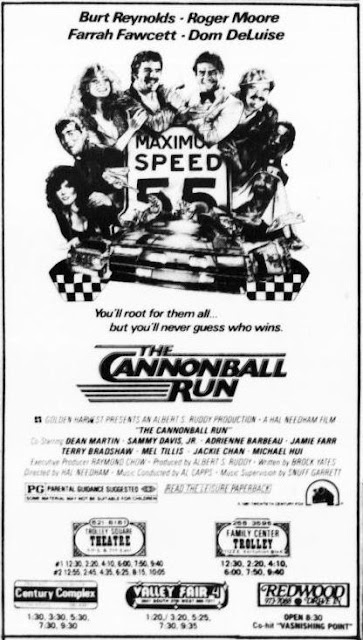
The classic road race movie The Cannonball Run was released on Jun 19, 1981, 30 years ago today. It starred Burt Reynolds, Dom Deluise, Roger Moore, Jamie Farr and a host of other celebrities like Jackie Chan, Farrah Fawcett, Dean Martin, Sammy Davis Jr, Terry Bradshaw and Adrienne Barbeau.
Watch the trailer:
Some interesting trivia about the film:
The film was originally going to be a straight up action flick starring Steve McQueen. After McQueen’s death, the lead was given to Burt Reynolds and the script was re-written as a comedy.
Many of the vehicles, including the ambulance driven by Reynolds and Deluise, were actually entered and run in the real life Cannonball races in the late 70s.
Roger Moore plays Seymore Goldfarb, Jr, a spoof of James Bond, who he was portraying at the time. In the race, he drives an Aston Martin which is famously linked to the British secret agent. However, Moore never drives an Aston Martin in the seven movies he appeared as James Bond. This movie is the only on-screen pairing of Moore and the famous car.
This movie features one of Jackie Chan’s first US appearances. His character is Japanese, even though Chan himself is Chinese. Chan was inspired by director Hal Needham’s use of bloopers during the end credits and from this point on would do the same in all of his own movies.
Burt Reynolds and Dom Deluise appeared together in Smokey and the Bandit Part II the previous year. This movie makes several references to that earlier movie including Reynolds mentioning the black Trans-Am and Deluise referencing his doctor character.
Watch the end credit outtakes
The Cannonball Run had two sequels. The first was The Cannonball Run II in 1984. Part II reunited the majority of the cast from the first movie. The second sequel was Speed Zone in 1989. The only returning character in the third movie was Jamie Farr’s The Sheik. The two leads were John Candy and Eugene Levy, friends who appeared together on SCTV and in the movie Armed and Dangerous. Their casting was an attempt to recreate the chemistry of original leads, and friends, Burt Reynolds and Dom Deluise.
This movie still holds up today. Reynolds and Deluise are hilarious and it seemed the entire cast had a blast filming the movie. Part II also holds up very well and fans may actually remember more scenes from Part II than the original.
Timothy Zahn’s Heir to the Empire was released at the end of May 1991 which makes it 20 years old. Heir to the Empire was the first “expanded universe” Star Wars novel since the Lando Calrissian solo novels in the 80s. It would become immensely popular and spark an avalanche of Star Wars novels that continues to this day.
The next two books in Zahn’s “Thrawn Trilogy”, Dark Force Rising and The Last Command, were released in 1992 and 1993 respectively.
The characters Zahn created in his trilogy became extremely popular and would be used by other authors for years afterward. Grand Admiral Thrawn, the Empire’s strategic military genius, would be one of the more popular. However Thrawn as a character would not really be written by anyone other than Zahn. Mara Jade would be used by many authors up until the current day. She would go on to marry Luke and have his children. Talon Karrde, smuggler extraordinaire would also prove popular and show up in novels from time to time, as would the New Republic’s military strategist, General Garm Bel Iblis. Zahn’s three books would also popularize the idea of clones in the Star Wars Universe as well as be the first to use the formal name of the Imperial homeworld (and current Republic homeworld); Coruscant.




 Cavalcade of Awesome