Archive for the Classic literature Category

AWESOME-tober-fest 2016: Lot 249 (1892) – Sir Arthur Conan Doyle

Posted in books, Classic literature, monsters, mummy with tags , , , , , , , , on October 10, 2016 by Paxton

Awesometoberfest banner

Sir Arthur Conan Doyle’s short story, Lot 249, was originally presented in a collection of medical stories called Round the Red Lamp.

Round-the-red-lamp

Published in 1892, this collection of short stories created a scandal when first released. Doyle’s fans were expecting more Sherlock Holmes-type detective and crime stories but this collection featured mostly harrowing medical stories about disease and amputation.

The story I read is called Lot 249 and is about an Oxford college student whose downstairs neighbor may or may not have reanimated an ancient Egyptian mummy through some type of dark magic.  This story was written during a late 19th-Century fascination with Egyptology and was the very first to use a reanimated mummy as the antagonist and would influence horror stories for years afterward.

It’s a short, quick read.  It reminded me a lot of Lovecraft’s Herbert West story in style, which wouldn’t be published for another thirty years.  Lot 249 is mostly three characters interacting over the course of a few days.  We get the details of the events through dialogue after the fact.  We don’t really see any of the mummy attacks.  We actually don’t really even get to see the mummy walking around.  There are a few quick glimpses in the coffin, but that’s about it.  And surprisingly enough, the story is wrapped up completely with no “will the mummy actually come alive again” type cliffhanger ending.  You could almost argue that there’s no definitive proof that the mummy did in fact come alive and start killing people.  Like I said, a lot of the eyewitness testimony is coincidental and hearsay.  Doyle leaves it up to the reader to fill in the blanks however he wants.

It’s an interesting story to read from the perspective of that this will influence the “creeping mummy” horror genre for so many years to come.  I’m glad I included it here, even if it isn’t the most exciting story I’ve ever read.  I’m a fan of Doyle and was glad to be able to include him in this year’s AWESOME-tober-fest.

In 1990, Lot 249 would be adapted as one of the chapters in the Tales from the Darkside: The Movie.  The adaptation in that movie would be written by Michael McDowell who also wrote the movie Beetlejuice and the movie novelization for Clue: The Movie.  It would star a very young Steve Buscemi, Julianne Moore and Christian Slater.


2012 banner
Also, check out the blog Countdown to Halloween for more Halloween-y, bloggy AWESOMEness.
AWESOME-tober-fest 2016: The Ring of Thoth (1890) – Sir Arthur Conan Doyle

Posted in books, Classic literature, Halloween, holiday, monsters, mummy with tags , , , , , , , , on October 3, 2016 by Paxton

Awesometoberfest banner

Here we are! Day 1 of AWESOME-tober-fest! Welcome to my daily celebration of all things spooky. As you can tell, my theme this month is “mummies”! So I’ll be looking at books, comics, movies and TV shows that feature mummies. It should be a lot of fun. Today, we’ll start with a short story by Sir Arthur Conan Doyle.

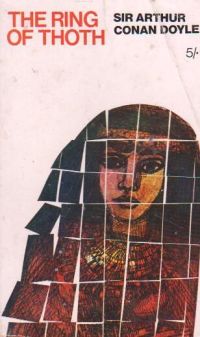
In 1890, Cornhill Magazine published a Sir Arthur Conan Doyle short story called The Ring of Thoth.

thoth056337

While this story has a mummy in it, it isn’t technically a “mummy story” like you’d expect. However, it has elements in the story that will clearly influence mummy movies in the many years to come afterwards.

The story is about an Egyptology student who falls asleep in The Louve and winds up locked in overnight and witnesses a bizarre sight.  The overnight caretaker unwraps one of the mummies from the collection, embraces and kisses it, then rummages through some of the jewelry in the Egyptian collection clearly looking for something.  The student is discovered in hiding and the strange looking caretaker reveals his story about living in ancient Egypt, discovering a long living chemical serum and losing the love of his life to a plague.

This story is short, obviously, and very concise with much of the backstory filled in by exposition from the museum’s overnight caretaker.  However, the way the story is written you feel a sense of wonder at the caretaker’s tale as well as a sense of urgency at what he plans to do that very evening.  These two things make the story breeze by.  It’s also interesting and it keeps you reading along with its fantastical story ideas.  Plus, as I mentioned, there are elements within the story that have clearly influenced many successor mummy movies but also the original Karloff Mummy movie.

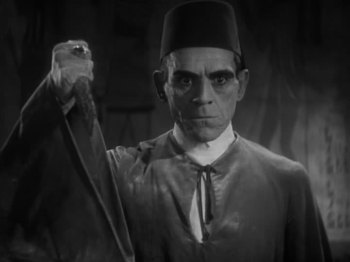
First of all, the strange looking caretaker, Sosra, is described as being a very tanned and overly wrinkled person.  Someone with much wisdom and experience in his eyes.  From the description, I immediately got an image of Karloff in his Ardath Bey disguise from The Mummy.  There’s even a scene in which Sosra threatens the protagonist with a knife, much like in the picture below.

vlcsnap-00100

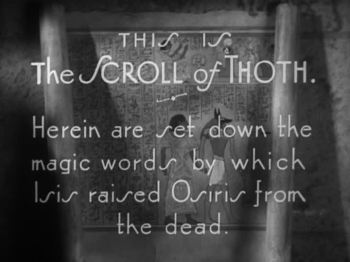
Second, the trinket that Sosra is looking for is the title bearing The Ring of Thoth. Thoth is the God of Knowledge in ancient Egyptian culture. His name would be used in countless mummy movies, however, this story would be one of the first. Universal’s The Mummy used it as well in describing, not a ring, but a scroll.

vlcsnap-00089

Like I said, while this story doesn’t necessarily involve a reanimated mummy it does carry several things that would influence mummy stories and movies in the years to come. Including a story Doyle would write just two years later called Lot 249.

Overall, this is a really enjoyable, short read.  The timeline is very compact and you feel like there is some urgency in the main characters.  It keeps the action moving along despite that the majority of the story involves backstory exposition.  This is definitely a recommend.


2012 banner
Also, check out the blog Countdown to Halloween for more Halloween-y, bloggy AWESOMEness.
AWESOME-tober-fest 2015: Comic adaptations of HG Wells’ The Invisible Man

Posted in books, Classic literature, comic books, monsters, pop culture with tags , , , , , , , on October 5, 2015 by Paxton

Awesometoberfest banner

I’ve always been a fan of comic book adaptations of classic literature.  The most famous versions of this are the Classics Illustrated line of comics from the 50s and 60s.  But several other companies jumped on that bandwagon over the years.

The original HG Wells novel was adapted several times in comic book form. Here are a few of them.

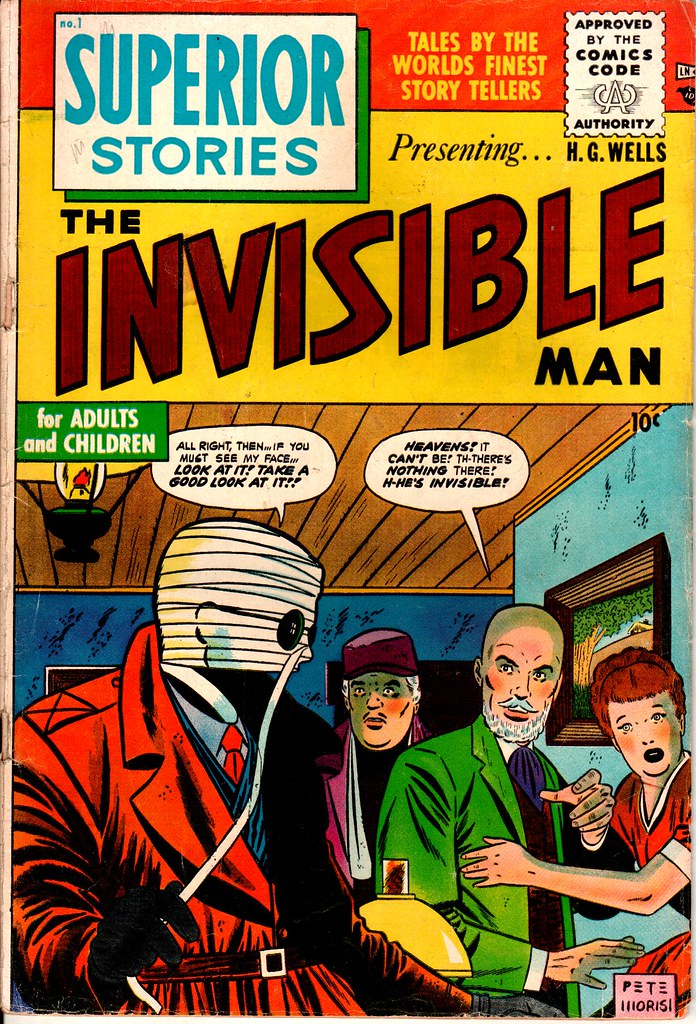
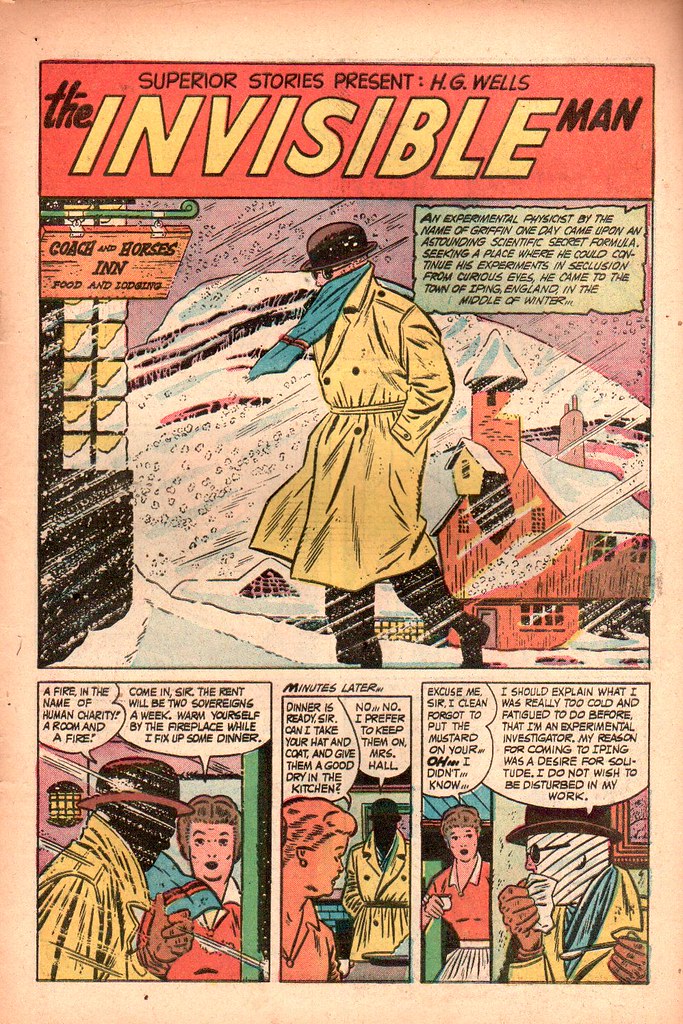
Superior Stories #1 Superior Stories 01 interior
In 1955, Nesbit Publishing released Superior Stories #1 which featured an adaptation of Wells’ novel. Art and inks were done by Pete Morisi.  It was a mostly faithful adaptation except that they ended the story with the death of the lead character and did not include the epilogue from the novel involving the character of Thomas Marvel.  Nearly ten years later this exact adaptation would be reprinted in Fantastic Adventures #18.

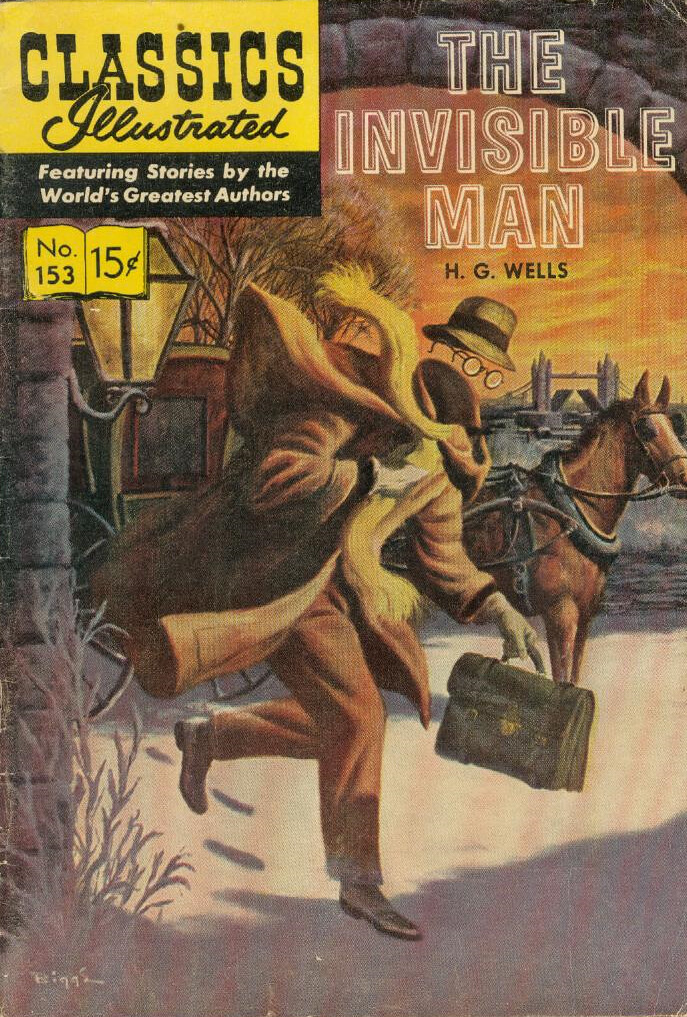
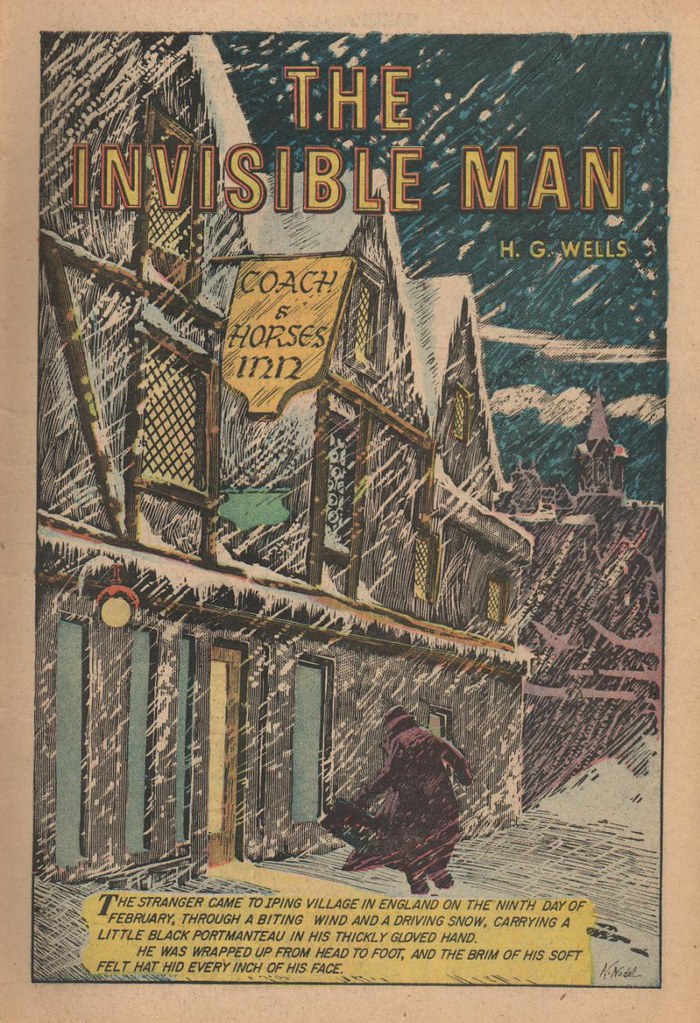
Classics Illustrated Invis Man cover Classics Illustrated title page
In 1959 Classics Illustrated #125 would feature an adaptation of the Wells novel with art by Geoffrey Biggs.  As in the last comic, this adaptation also ends with the final fate of the invisible man and completely cuts out the novel’s epilogue.  It makes me wonder if these comics were actually adapting the Universal movie instead of the book.

Marvel Comics would adapt the Invisible Man novel twice.

Marvel Supernatural Thrillers 01 Marvel Supernatural Thrillers 02
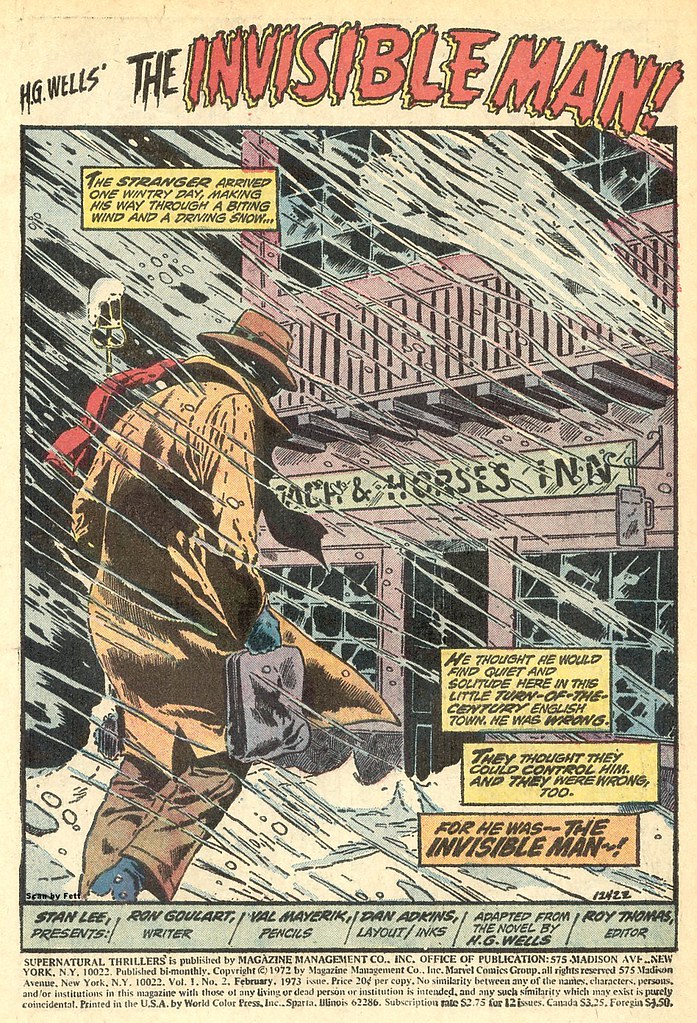
Marvel Supernatural Thrillers #2 from 1973 would feature an adaptation of Wells’ novel. It had a script by Ron Goulant and art/layouts by Dan Adkins and Val Mayerik.  The art looks pretty great in that early 70s Marvel style that I love so much.  Unlike the Classics Illustrated adaptation above, this comic features the epilogue.

Marvel Classics Comics 25 cover Marvel Classics Comics #25 title page
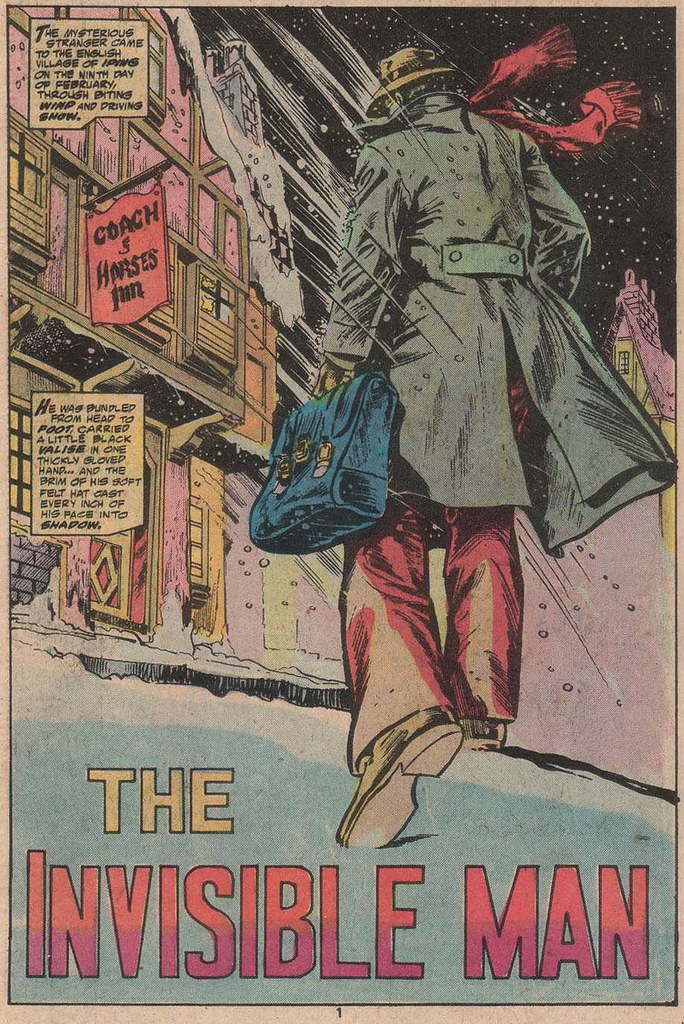
In 1977, Marvel Classics Comics #25 would again adapt the novel but this time with art by Dino Castrillo and Rudy Messina and a script by the great Doug Moench.  I’m surprised they didn’t just reprint the Supernatural Thrillers adaptation from four years earlier in this issue, but the art and layouts are great here as well in that 70s Marvel horror style.  And yes, this adaptation also includes the novel’s epilogue.  Not sure why the first two comics omitted it.


2015 banner
Also, check out the blog Countdown to Halloween for more Halloween-y, bloggy AWESOMEness.
AWESOME-tober-fest 2015: The Invisible Man (1897) – HG Wells

Posted in books, Classic literature, monsters, pop culture with tags , , , , , , , on October 1, 2015 by Paxton

Awesometoberfest banner

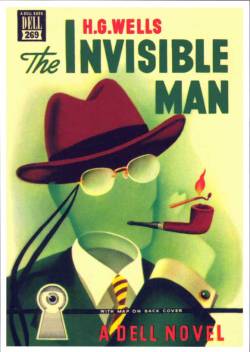
Yesterday, I talked about one of the very first uses of invisibility in literary fiction. Today, I’m going to discuss probably the most well known use of invisibility in literary fiction.  I decided to go ahead and lead with this book because so much of invisibility in pop culture is derived either from this novel or from Universal’s 1933 movie adaptation, which I’ll review tomorrow.

The Invisible Man was HG Wells’ fifth novel after such classics as The Time Machine and The Island of Dr Moreau. It was originally serialized in Pearson’s Weekly in 1897 but collected into a novel that same year.

Invisible-man

Surprisingly, I had never read this book. I thought I would have been assigned it in high school or college, but that can also be said for several other classics I recently read for AWESOME-tober-fest like Frankenstein and Dracula.  Due to this I, again, have to thank AWESOME-tober-fest for manufacturing a reason for me to shoehorn this book into my reading list.  Let’s see if it was as good as Frankenstein or as bad as Dracula.

The book is certainly well written.  It begins with a mysteriously bandaged man arriving at a boarding house in the small English town of Iping.  The bandaged man not only looks mysterious, he is a very impatient man.  He immediately starts rubbing everyone the wrong way and eventually is kicked out of the boarding house when he can’t settle his bill.  This leads us to discover that he was a scientist who invented an invisibility serum and tested it on himself.  He was trying to work on a reversal serum when he arrived in Iping.

While down and out, he tries to rely on several people for help, but can’t seem to get it together.  All the while, he’s slowly going crazy from the chemicals he’s used on himself and fashions the idea that he’s going to take advantage of the invisibility and start a reign of terror to take over the country, starting with the citizens of Iping.  Will he succeed?

invisible-man-poster

The story is very well told.  I like the “mysterious stranger” beginning of the novel (despite that the mystery is completely dissolved by the blatant title of the novel).  Seeing Griffin arrive, begin behaving strange and treat everyone so contemptuously is a very in your face way to start the novel.  And I like it.  Eventually, the events that precede the novel are discussed at length about two thirds of the way into the story and by then, you are ready and anxious to hear how Griffin got to where he was.  And HG Wells doesn’t disappoint with the “science-y” talk.  While much of it might be well sounding gibberish, it certainly sounds impressive to hear Wells explain the invisibility science through Griffin.  And there were several disadvantages to invisibility that Wells mentions that I didn’t expect to be brought up like not being able to sleep because you can see right through your eyelids, or that you can see food digesting in your stomach for an hour after you’ve eaten.  Even down to the weather like rain or snow collecting on your head and shoulders making you visible again.  Or dirt and mud collecting on your feet and fingernails also making you visible.  I had expected these things to have come out of later novels and movies, but not this original story.

Things I didn’t like.  The book seemed a little long.  It felt like Wells was padding out the pages a little.  Especially during the scenes where Griffin is discussing what he did before the beginning of the novel.  Some of that stuff is great, but it also felt a little too long.  And some of the side characters have crazy dialects.  It’s supposed to be English countryside dialect, and I can’t speak to the accuracy of that, but it’s damn near unreadable.

But those are small nitpicks, honestly.  I would recommend this book.  Is it as good as Shelley’s Frankenstein?  No, but it’s definitely a good, fun read and I’m happy to say not complete garbage like another classic monster book I know (looking at you Dracula).


2015 banner
Also, check out the blog Countdown to Halloween for more Halloween-y, bloggy AWESOMEness.

AWESOME-tober-fest 2015: What Was It? A Mystery (1859) by Fitz-James O’brien

Posted in books, Classic literature, Genres, Halloween, holiday, horror, monsters, pop culture with tags , , , , , , on September 30, 2015 by Paxton

Awesometoberfest banner

And we are off! So, I had planned on beginning AWESOME-tober-fest 2015 on October 1, but I got excited and I’ve decided to start one day early. Today. So, enjoy everyone, my discussion of all things invisible man begins NOW.

Usually with any discussion of invisible men, ground zero is assumed to be HG Wells’ 1897 story, The Invisible Man. And yes, that is probably the most important work on invisibility to date. And yes, I am going to review that book (check back tomorrow). However, Wells’ story wasn’t the first to feature invisibility, or an invisible man.

harpers-weekly

In 1859 Harper’s Weekly published a short story by Fitz-James O’Brien titled What Was It? A Mystery.  O’Brien is considered to be one of the forerunners of science fiction.  And this particular short story is considered one of the earliest known uses of invisibility.  It predated HG Wells’ story by nearly 40 years.

I was doing research on invisibility for this month and discovered an anthology from the 70s that included stories about invisibility.  It was called Invisible Men and it’s edited by Basil Davenport.

invisible-men-anthology

I looked through the list of stories included. There is one from Wells himself, but not the titular Invisible Man.  It’s another story entitled The New Accelerator. O’Brien’s short story was also included. Doing a little more research I discovered the history behind O’Brien and this particular story and decided that I should give it a read.

It’s a very interesting and atmospheric story.  It’s based in an old apartment building and features several of the renters.  One of them is attacked by an unseen force one evening.  The unseen force is captured and tied to the bed.  The renters try to figure out what it is and even take a plaster cast of it.  But the invisible being dies before they can discover what it is.  That’s the long and short of it.

It’s structure is very similar to a lot of Lovecraft’s early stuff.  The story is told by a narrator from the present who is relating events that happened in the past.  The events are never really fully explained and it leaves you with an uneasy, creepy feeling.  Another similar story that comes to mind is Sir Arthur Conan Doyle’s short and creepy The Ring of Thoth as well as Lovecraft’s Out of the Aeons.

And that is What Was It? A Mystery, one of the first uses of invisibility in literary fiction.  It was a fun and interesting read.  Especially to set the table for the movies and books to come this month.


2015 banner
Also, check out the blog Countdown to Halloween for more Halloween-y, bloggy AWESOMEness.