 Imagine you are a kid, at home, after a long day of school in 1986. You are sitting mindlessly watching the TV enjoying your favorite cartoons when the announcer says to stay tuned for the Ghostbusters. What? Hellz Yeah, Ghostbusters cartoons? Bring It! You are sitting there with your pouch of Capri-Sun ready to watch Slimer and the Ghostbusters kick some spectral butt. The show comes on and something looks off……..I didn’t realize the Ghostbusters hung out with …….is that a……..gorilla?! WTF?! This is what happened to me when I was about 12 years old. I was greeted with a Ghostbusters cartoon that was foreign to me. Was this just simple greed by a company looking to ride the wave of ghostbustin’ popularity, or was there more to it? This cartoon even used the actual name GhostBusters. What was this cartoon’s story? Well, after much research, I finally found out.
 The Ghostbusters are pop culture icons. Ray, Peter, Egon and Winston.
  The phenomenally successful movie that spawned this group has entertained people of all ages. However, surprisingly enough, Columbia did not have the rights to the name “ghostbusters” before or during the filming of their titular 1984 blockbuster. Who owned the rights to the name, Ghostbusters? It was a production company called Filmation. After Ghostbusters hit it big in 1984, imitators began coming out of the woodwork. Companies were trying to ride the coattails of the hit movie with toys, games and cartoons with a similar theme. As stated earlier, if turned on your tv in 1986 you may have caught a show involving two friends and their gorilla using crazy equipment to capture ghosts. This cartoon was called Filmation’s GhostBusters. This series was created by Filmation, the aforementioned rights holders to the name Ghostbusters. Why did they have the rights and how did this cartoon come about? It all starts in 1975.
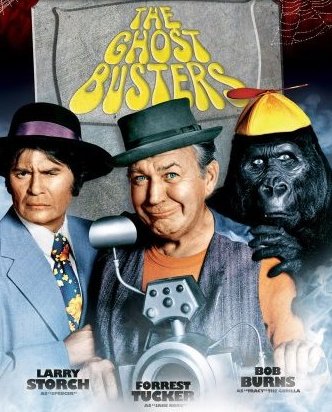 In 1975 and 1976, Filmation filmed a live action tv series called The Ghost Busters. It starred Forrest Tucker as Jake Kong, Larry Storch as Eddie Spencer and Bob Burns as Tracey the Gorilla (For the younger crowd, in the wacky ’70s-’80s a gorilla or monkey was a viable co-star, see BJ & The Bear or Any Which Way But Loose). The three were bumbling detectives that would stumble their way through cases to ultimately defeat various scary monsters (vampires, werewolves, witches and, of course, ghosts). They used a motley collection of electrical equipment to defeat the monsters including a light emitting camera-like device to send them back to the underworld. It was a moderate success but faded quickly as it ran for only one year.
Fast forward to 1984. Columbia has finished filming their Ghostbusters movie. They realize that they will have to call it Ghostbusters as the term is used throughout the script and the final showdown scene in New York has a large crowd of people chanting the name. They have to bite the bullet and pay Filmation royalty rights to use the name. It’s a bitter pill, but Columbia swallows it. The movie becomes a huge hit and the studio wants to follow up on the film’s success with a cartoon show.
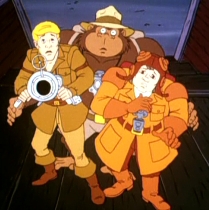
 During the ’80s and ’90s, the Filmation studio was an immensely popular Saturday morning cartoon producer. They created the cartoons He-Man and the Masters of the Universe, Fat Albert, She-Ra, Star Trek The Animated Series, The Batman/Superman Hour and many, many more. With this pedigree, and the fact that they owned the name Ghost Busters, they naturally thought that they would get first crack at producing the animated Ghostbusters show. After much negotiation, Columbia backed down and said that they were going to focus on a live action Ghostbusters sequel and not do a cartoon series. Rebuffed, Filmation decided to capitalize on the Ghostbuster name by creating their own cartoon but based it on their original tv series. The cartoon’s premise had the sons of the original tv characters inheriting the business and continuing the fight against supernatural evil. For the first five episodes (technically a mini-movie), Larry Storch and Forrest Tucker reprised their roles and voiced their characters for the first time in 10 years in order to pass the torch to their sons. Bob Burns, the actor behind Tracey the Gorilla, would continue to voice Tracey in the new cartoon. The concept was set and the show debuted in February 1986.
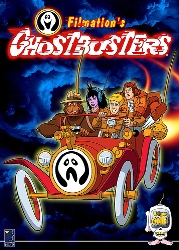 Columbia, having gone through some changes in management since the negotiations with Filmation, were a little perturbed that another studio would get a cartoon bearing the name of their cash-cow movie franchise on the air before them. Especially the studio that owned the name Ghost Busters. This lead to Columbia partnering with cut-rate studio DIC Animation to get their Real Ghostbusters cartoon on the air. Filmation had to add “The Original” to their cartoon to make it stand out from Columbia’s cartoon. Needless to say, this still causes confusion amongst Ghostbusters fans who have no idea about the 1975 tv show.
The Filmation cartoon and live-action Ghost Busters shows were just released on DVD and can be found on Amazon.
Ghostbuster Video Links:
1. Check out the intro to the Original Ghostbusters cartoon (and its kick ass theme song) here.
2. You can see the intro to the 1975 The Ghost Busters live-action show here.
3. Intro to the Real Ghostbusters cartoon can be seen here.
I personally really enjoyed the show. It was clever and funny and the characters were awesome. The theme song was really cool too. When the GhostBusters would get a call on the Skele-phone they would scream, “Go-Go-GhostBusters!” and slap high fives. Lots of fun. I got the DVDs off Blockbuster Online and I’m still enjoying watching them. Check it out if you get the chance.


Technorati Tags – Ghostbusters movies TV Shows Ghost Busters pop culture


 Do you remember any of the other products in the Rubik family? The original Rubik’s Cube is a 3x3x3 cube. I remember a keychain version of the 3x3x3 cube being extremely popular in my elementary school. Did you know they also made a standard Rubik’s Cube in braille (
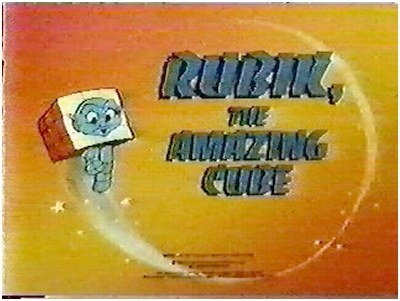 Speaking of time wasters, does anyone remember the Saturday morning cartoon show Rubik, The Amazing Cube? Anyone? Hello…? Well, for some reason, I remember it. Before writing this article I remember thinking the theme song kicked all kinds of ass and that it was a really cool show. Well, after a little searching, I found a clip on YouTube from the show. If you
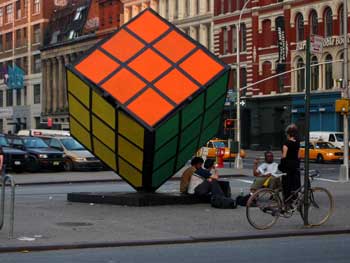
  Apparently there’s a cube sculpture in Astor Park in New York (see pic left). It constantly gets de-faced with graffiti by the neighborhood youth. For a really good prank, a group of guys got together and turned it into a Rubik’s Cube.
 Well, that’s some of the ca-RAZY crap you could find thanks to the international phenomenon that was Rubik’s Cube. Do you still have yours? I have mine. I never actually solved it the “correct” way, I just took it apart and put it back together so it is in it’s solved state. Hey, it may not be the way IDEAL intended you to solve it, but it works.
 If you’ve been watching American Idol the last few weeks you’ve no doubt noticed the numerous promos for a show called
 Fast forward to 1968. Brock Yates is an executive editor for Car & Driver magazine. He writes a scathing article called “The Grosse Pointe Myopians”, which critiques the auto industry, its management and its products which makes him infamous within the auto industry. Then, in 1971, Yates, along with fellow Car & Driver editor Steve Smith, decides to create an unofficial, and illegal, intercontinental road race. Inspired by the travel records of Erwin “Cannonball” Baker, the race begins in New York and ends in Redondo Beach, CA. Officially dubbed the Cannonball Baker Sea-To-Shining-Sea Memorial Trophy Dash, the race would serve as a celebration of the US national highway system and also a protest of the soon-to-be passed 55mph speed limit. Yates wanted to prove that careful drivers can safely navigate this country’s interstate system at high speeds in much the same way the Germans do with the Autobahn. Yates also believed that if Erwin Baker could complete the journey in a record time of 53 hours and 30 minutes over unfinished roads and horrible conditions, then a modern driver should have no problem doing it over the uninterrupted expanse of the national interstate system.
 After the dismantling of the race, Yates wrote about his experiences in a movie screenplay. Before he could get the film made, he was beat to the movie theaters by two movies;
  “Cannonball Run 2001”. It would be the precursor to the currently popular Amazing Race. Suprisingly, there are many movies BEFORE Cannonball Run that included a cross country vehicle race.
 # Walt Disney holds the record for having the most Academy Awards: 22 won, and 4 honorary.
 So, I’ve been in training this week. Yes, again. This particular week we are learning about PeopleSoft Billing and Accounts Receivable. Awesome, huh? I get goose-bumps just talking about it. Seriously, the atmosphere in this class is like the encore at a Lynard Skynard concert. They just started singing Free Bird, lighters are lit and raised, people are losing their minds. It’s almost a religious experience. Oh yeah, I’m completely lying, it’s as boring as
  Chocolate itself has been enjoyed, as a drink, since the early 16th century. Montezuma, ruler of the Aztecs, the conquistador Cortez, and many of the royal families in Spain have enjoyed drinking chocolate as a beverage. It wasn’t until the mid-19th century in England that chocolate was consumed as a non-liquid confection. Actual bars of chocolate start showing up in the late 1800s. Candy shops would sell off chunks of excess chocolate from their store supplies in order to wring every last penny out of their inventory.
  In 1920, the Curtiss Candy Company started producing the Baby Ruth candy bar. Since that time, the origin of the bar’s name has been debated over and over. The official story is that Baby Ruth is named after the daughter of former President Grover Cleveland. Another story contends that the company was looking to capitalize on Babe Ruth’s popularity without paying royalties. Which is true? We may never know, BUT let’s look at some facts. Baby Ruth was introduced in 1920. Grover Cleveland’s last year of office was in 1897, 23 years prior. Grover’s daughter, Ruth, died at age 12, 16 years prior. Babe Ruth was traded from the Red Sox to the Yankees in 1920 and was coming into the height of his popularity. It may all be coincidence. Apparently Ruth Cleveland was born in-between Grover’s two terms in office and, at the time, was a national sensation. Why, though, it took 16 years to get a candy bar named after her, I don’t know. It’s also said that the bar was named after the granddaughter of one of the original formula’s developers. Since he was a nobody, the whole story was concocted as a marketing gimmick. That one is interesting too, but it’s all speculation at this point. An interesting footnote, in order to combat the mis-use of his nickname, Babe Ruth released a candy bar officially endorsed by him.
  I’ve always enjoyed the “look” of the Zero bar (see pic). I don’t know if you’ve ever had one, but it looks cool, even if it tastes a little weird. I always wondered why they called it Zero. What’s zero? Calories? No. Fat? No. WHAT?! Well, if you look
  Did you know 3 Musketeers was originally three small candy bars in one package, hence the name? Also, each bar had a different flavor (chocolate, vanilla and strawberry). Interesting how that concept got lost, huh? Now, the 3 Musketeers bar is a flat taffy-like candy. WTF?!


 Cavalcade of Awesome